the part of journey nobody talks about

I have been sitting with a concern with the psychedelic professional ecosystem for a while now.

Not a concern with the field as a whole, exactly. The psychedelic healing conversation has matured in extraordinary ways and continues to do so. The research is serious and growing. The cultural permission and acceptance is widening. The frameworks being developed for therapeutic support are sophisticated and essential.  The ceremonial frontier is starting to become more scrutinized for a higher ethical standard. (Well.. as much as possible without any uniform oversite in the wild west liminal space we currently reside in.)

The frustration is with a single, persistent imbalance. Or dare I say near absence.

The talk about integration is constant. But I almost never hear anything about preparation.

Integration has become the organizing word of the contemporary psychedelic healing conversation. When practitioners gather, when researchers publish, when guides advise their clients, integration is the “key” everyone is navigating toward. Every other coach on linkedIn is an integration specialist.  And therapists are rapidly coming on board proclaiming their chops to land the craft. How to capture what the journey unearthed. How to metabolize the insights, embody the revelations, and let the medicine’s intelligence reorganize a life.

These are critically important aspects of the journey arc by all means. Many adept practitioners have built serious frameworks and resources around integration contributing something real and necessary to this field.  I personally grateful for their essential work.

But after five years and hundreds of ceremonies, a conviction has taken root in me that will not be argued away.

The quality of preparation is the single greatest predictor of a journey’s depth, coherence, and lasting impact.

Not the type of medicine. Not the setting. And not the amazing integration framework waiting on the receiving end.

What a person brings to the critical threshold, a highly dynamic and often volatile journey experience, is the vessel into which the experience pours itself into. And most of the field is paying almost no attention to the care and quality of the vessel.

The psychedelic conversation treats preparation largely as logistics. Screen for mental health flags. Know your medicinal contraindications. Set a clear intention. Ensure a safe environment. Show up well-fed and well-rested.  Get into the deep end of the pool.

Again, these considerations absolutely matter and are essential for a safe ethical journey.

But they are not the intimate elements of intentional preparation that I am referring to here.

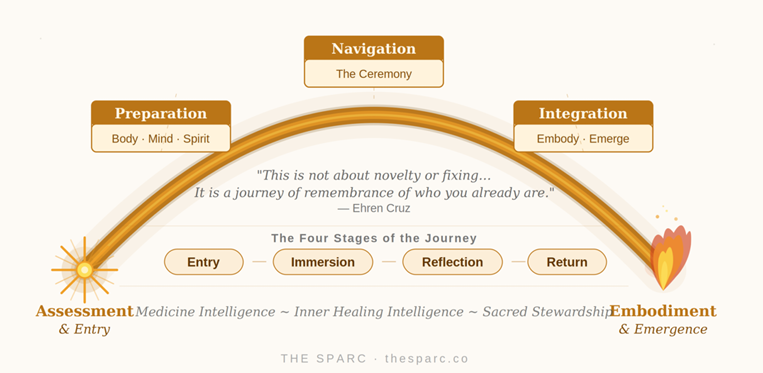
Genuine preparation is the cultivation of the whole human being; body, mind, and spirit, in the weeks and months leading up to the high intensity experience.

The people who arrive at the mat resourced, practiced and inhabiting a living relationship with their own wellbeing access categorically different terrain than those who arrive depleted, untrained, and unanchored. The medicine meets everyone exactly where they are, but it does not meet everyone equally.

Preparation begins in the body.

The nervous system is the primary vehicle that governs the resilience of the psychedelic experience. Every somatic wave, every emotional peak & valley, every sensation of dissolution or expansion from profound grief to ecstasies moves through the body’s living tissue. A body arriving at the threshold undernourished, chronically stressed, sleep-deprived, running entirely on sympathetic activation, does not have the adequate resources to support the often

Whole foods. Clean hydration. Real sleep. These are not supplementary details. They are the foundational essentials. I encourage clients in the weeks before a journey to treat their relationship with food as a deeply intentional practice. Mineral-rich vegetables, quality proteins, greatly reduced alcohol and refined sugar intake, generous amounts of clean water ensure a powerful container for the experience. A body nourished at the cellular level is a body that can mobilize real resilience and resource.

Rest also deserves its own emphasis. Beyond quality of sleep itself with of key importance, is genuine restfulness. The parasympathetic nervous system needs real opportunities to establish its ground before the ceremony asks for its fullest expression. A nervous system running on chronic activation will treat the journey as threat rather than invitation. The difference in how the experience unfolds from that distinction alone is palpable. It’s also important to remember that medicine like psylocibin is a serotonergic compound. If the body already has a relationship with the receptive and satiated serotonergic state through self-care, the transition into coherency is a much less dramatic leap for post journey synthesis. It’s all too common that journeyers experience a catharsis that is too far afield from their normative contracted state, leaving them susceptible to a “rubber-band” back to their traditional depleted state afterward.

Movement practice in the weeks of preparation serves a dual purpose. Physically, practices such as yoga, qigong, hiking or more rigorous training build the body’s capacity for conscious sensation: the ability to feel what is present and tolerate discomfort without immediately reacting to it. This is exactly the capacity the journey calls upon most directly. Energetically, these practices cultivate malleability, a quality of suppleness and resilience that allows the system to move with the medicine’s current rather than brace or contract against it.

The body is not just the container for the journey. It is an active participant in the healing process itself. Treating it that way in the weeks or months before the ceremony changes what the ceremony can really bring.

Mental fitness is the second domain of genuine preparation, and it is where the gap between what most people arrive with and what the journey actually asks for is most pronounced.

A macro-dose psychedelic experience is one of the most intense and unpredictable states a human nervous system can encounter. Vivid somatic sensations arising in waves. Emotions surfacing from depths the person may not have accessed in years, sometimes decades. Insights arriving with the force of paradigm shifting revelation. Long dormant wounds emerging with startling clarity. The shadow material the unconscious has carefully managed presenting itself for a direct encounter. And so much more…

The mind with no training in present-moment awareness enters this territory largely unequipped to deal with the sensory onslaught coherently. Across hundreds of sessions, without adequate preparation, I have watched three default responses play out with near-universal consistency regardless of age, gender, or vocation: Sympathetic flight, fight, or freeze responses. Mental flight into narrative and analysis, the running commentary that replaces presence with skewed interpretation. The hardening of resistance against what the system judges as too much. Or the complete overwhelm of any witnessing capacity, where the person has no interior ground from which to observe what is happening leading to acute disassociation.

A consistent meditation or contemplation practice, even a modest one begun two to three months before the journey, changes the nature of this encounter.

The Theravada Buddhist tradition describes this as the development of sati: the capacity to know what is happening as it is happening without being immediately captured by the demand that it be different. The meditator who has sat with their own mind long enough to recognize thought as thought, emotion as emotion, sensation as sensation, arrives at the journey with something the untrained mind does not have. A witness. A quality of interior ground from which to observe the landscape of the experience without being entirely submerged by it.

This does not make the journey easier, necessarily. It makes it more complete.

The person who can feel profound grief without dissolving into it allows the grief to move to its natural completion. The person who can recognize fear arising without immediately contracting around it creates the opening through which the medicine’s intelligence can support a cathartic release. Carl Jung described the unconscious as carrying exactly the material the ego has refused to face. The journey will find that material with extraordinary precision. A trained mind meets the encounter. An untrained one often flees from it.

Alongside formal meditation, I encourage journeyers to engage in honest self-inquiry in the weeks before the ceremony. Journaling, engaging in depth work with a therapist or mentor, somatic therapy, and tuning into real vulnerable conversations with trusted allies. The medicine will find the places in you that have rarely been looked at directly. Arriving with some acquaintance with those territories, even a tentative one, changes the nature of the encounter. Awareness can make all the difference.

An important consideration about mental health, because this deserves directness. For people navigating significant depression, PTSD, CPTSD, anxiety, or addiction, the path toward these practices may not be linear. These conditions directly affect the capacity to inhabit some of what I am describing. Even a baseline foothold in some form of wellness practice creates meaningful difference in the retainment of insights and the sustainability of healing post-journey. The invitation is not perfection. The invitation is earnest engagement. Any sincere movement toward embodied wellbeing in the weeks before a journey dramatically increases sustainability on the other side of it.

The third domain of preparation is the one contemporary secular culture finds most difficult to name, and therefore most frequently omits.

The domain of the spirit.

This is not about establishing a fixed or defined religious orientation.  This is the fostering of a living, felt sense of relationship with the world as something larger and more intelligent than the one’s personal orientation to it. It’s about developing a quality of trust in the unfolding rhythm of existence itself.  The fostering of a belief that the universe has its own design.  Its own unfolding. And that intelligence supercedes the mental faculties of egoic perceptional awareness.  This often begins, by developing an orientation of gratitude for the gift of life itself; the land, the creative beauty and the web of relationships that extends in every direction at every moment.

The research on mystical experience in psychedelic contexts is substantial and consistent. People who access a genuine sense of awe/wonder, transcendence, or contact with what feels sacred during a journey experience deeper healing during the experience and sustained effects afterward. This finding appears across the Johns Hopkins studies, the NYU cancer anxiety research, the MAPS PTSD trials and so many others. The quality of reverence accessible during the experience is among the strongest predictors of lasting therapeutic benefit.

You cannot manufacture a mystical experience. But you can cultivate the interior ground from which one becomes more possible.

Ceremony, ritual, and genuine attention to one’s living relationship with the natural world in the weeks before a journey are not decorative additions to the preparation process. They are creating an ecosystem of receptivity that can nourish the ground in which such revelations can take root. The person who has been spending real time in attentiveness to the world around them, who has been practicing some form of gratitude or devotion, who has been allowing themselves to feel the profound interconnectedness of their own life within the larger web of living systems, who deeply respects the light & shadow that are essential aspects of life itself, arrives at the threshold already tuned to a frequency the medicine is trying to reach.

Preparation of spirit is what transforms a psychedelic experience from a powerful psychotropic event into genuine Rites of Passage.

The psychedelic journey, held with genuine reverence and adequate support, is an initiation.

Ancient and indigenous ceremonial traditions understood something our contemporary, efficiency-oriented culture has nearly forgotten: the passage itself is only as powerful as the preparation that preceded it and the integration that follows it. You cannot sprint to a threshold that requires your whole attention and presence to cross.

The most enduring, most transformative journey outcomes I have witnessed share one common feature: a long thoughtful runway of entry. Not two weeks of dietary adjustment and a single preparation call. A couple of months of sincere engagement with holistic health, mindfulness, and spiritual attention that cultivate a fully prepared inner landscape to support the dynamic intensity of the experience itself.

This philosophy is at the center of the Inner Compass Transitions Mentorship program I have developed at The SpArc. Two to three months of devoted practice before the journey: holistic wellness, mindfulness cultivation, self-inquiry, nervous system training, and the development of a genuine living relationship with the world around you. Then the ceremony itself, held with adept and compassionate facilitation, sacred container co-creation, and a true sense of belonging. Then after the immersion, another four to six weeks of intentional, supported integration: with accountability, embodiment practices, and the deep alliance of a guide who knows where you have been and what you are hoping to embody on the far side.

People who arrive with two to three months of sincere preparation behind them access territory in a single journey session that others cannot reach in multiple experiences without that foundation. The preparation does not just prime the pump, it ensures genuine readiness and coherence for the courageous person arriving at the threshold. And only then can the medicine meets that person entirely.

Fill the Vessel First

Integration without preparation is catching water in a cracked vessel.

Preparing the body, the mind, and the spirit for one of the most profound experiences a human being can have is not a secondary conversation in this field.

It is half the journey itself.

And it is time we talked about it that way and embraced it as such.


Ehren Cruz, PCC is the founder of The SpArc, a psychedelic ceremonial facilitation center in the mountains of Western North Carolina. He has facilitated over 250 psychedelic journey experiences and works at the intersection of ceremonial medicine, Theravada Buddhist practice, and Jungian depth psychology. The Inner Compass Mentorship at The SpArc offers a full rites of passage arc: devoted preparation, ceremonially facilitated journey work, and supported integration. Learn more at thesparc.co

Experience The SpArc Newsletter!
Dive into the latest research, receive access special events & resources, and learn safe & ethical ways to explore the Psychedelic Renaissance!.

Sign up for the SpArc newsletter and receive a free 15 page mindful preparation, navigation, integration and synthesis guide!”